

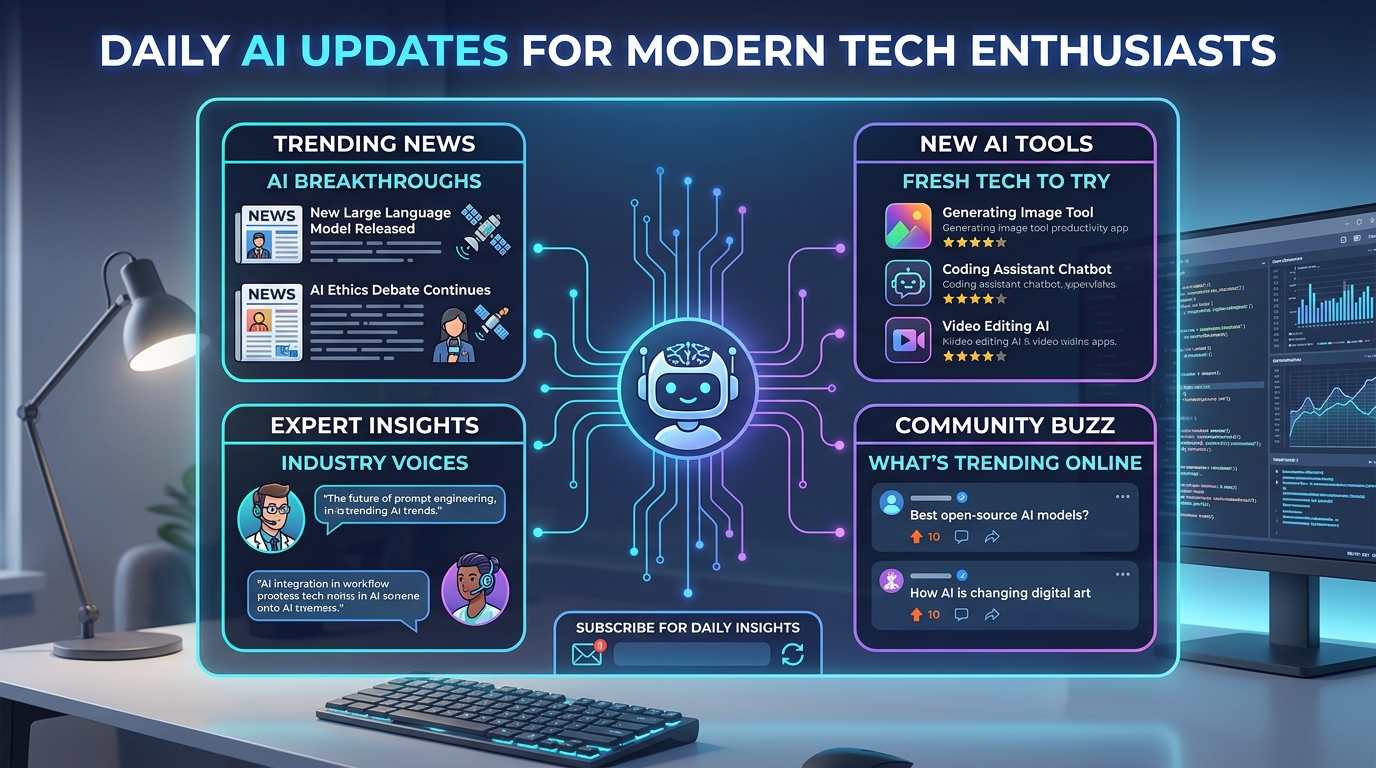
Today’s daily AI updates for modern tech enthusiasts reflect how rapidly artificial intelligence is moving from experimental technology into everyday infrastructure. Across apps, devices, workplaces, and research labs, AI is becoming more autonomous, more multimodal, and more deeply integrated into global digital systems than ever before.
AI Agent Ecosystems Expanding Across Platforms
AI Agents Taking Over Task Automation
AI systems are increasingly acting as independent agents capable of completing multi-step tasks such as booking, coding, scheduling, and data analysis. Instead of responding only to prompts, they now execute workflows across multiple apps with minimal user input.
Personal AI Assistants Becoming More Context-Aware
Modern AI assistants are learning long-term user preferences, allowing them to adapt responses, predict needs, and proactively suggest actions. This shift is making AI feel more like a personalized digital partner than a static tool.
Cross-App AI Integration Growing Fast
Tech ecosystems are integrating AI directly into operating systems, browsers, and productivity suites, enabling seamless actions across email, documents, messaging, and cloud services without switching platforms.
Multi-Agent Collaboration Systems Emerging
Multiple AI agents can now collaborate on complex tasks such as research, software development, and business planning, dividing work dynamically to improve speed and accuracy.
Enterprise Automation Driven by AI Agents
Businesses are deploying AI agents in customer service, HR, logistics, and analytics, significantly reducing manual workload and increasing operational efficiency across industries.
Breakthroughs in Generative AI Models
Next-Gen Multimodal AI Models
New AI systems can process text, images, audio, and video together, allowing users to generate and analyze content across formats in a single workflow.
Faster and Lightweight AI Models
Developers are releasing optimized AI models that run efficiently on mobile devices and low-power hardware without sacrificing performance quality.
Improved Reasoning and Logic Capabilities
Modern AI models are becoming better at structured reasoning, enabling them to solve complex math, coding, and planning tasks more reliably.
AI Memory and Personalization Upgrades
Models are now being designed with persistent memory features, allowing them to remember user context across sessions for more personalized interactions.
Domain-Specific AI Models Expanding
Specialized AI systems for healthcare, law, finance, and engineering are improving accuracy and reducing errors compared to general-purpose models.
AI in Everyday Consumer Technology
AI Search Engines Replacing Traditional Search
Search engines are evolving into conversational systems that provide direct answers, summaries, and actionable steps instead of lists of links.
AI in Smartphones and Wearables
Phones and wearable devices now include on-device AI for voice assistance, translation, photography enhancement, and real-time suggestions.
Smart Content Creation Tools
AI-powered tools are helping users generate videos, images, music, and written content instantly using simple prompts.
AI-Powered Productivity Apps
Work tools like email, spreadsheets, and note apps now include AI features for writing, summarizing, and automating repetitive tasks.
Personalized Recommendation Systems
Streaming platforms and shopping apps are using advanced AI to deliver highly personalized content and product recommendations.
Robotics and Physical AI Expansion
Humanoid Robots Entering Testing Phases
Robotics companies are testing humanoid systems designed for warehouse, retail, and industrial environments with improved movement and decision-making.
AI in Industrial Automation Systems
Factories are using AI-driven machines to optimize production lines, detect defects, and manage logistics operations more efficiently.
Edge AI for Real-Time Robotics
Robots are increasingly processing data locally using edge computing, allowing faster reactions without relying on cloud servers.
Vision-Based Robotics Advancements
AI vision systems are enabling robots to better understand environments, recognize objects, and interact safely with humans.
Human-Robot Workplace Collaboration
Robots are being designed to assist rather than replace humans, working alongside workers in manufacturing and service industries.
AI in Science, Research, and Innovation
AI Accelerating Scientific Discovery
AI systems are now used in labs to simulate experiments, analyze large datasets, and generate hypotheses for faster research outcomes.
Breakthroughs in Drug Discovery
Pharmaceutical research is increasingly powered by AI models that predict molecular behavior and speed up drug development.
AI in Climate and Weather Prediction
Advanced AI models are improving accuracy in climate forecasting and environmental risk analysis.
AI-Generated Engineering Designs
Engineers are using AI to design structures, materials, and systems optimized for performance and efficiency.
Autonomous Research Systems
Some labs are experimenting with AI systems that independently run experiments and refine results without continuous human supervision.
AI Safety, Ethics, and Regulation Updates
Global AI Regulation Expansion
Governments are introducing stricter policies to regulate AI usage, focusing on transparency, accountability, and safety standards.
AI Content Detection Systems
New tools are being developed to detect AI-generated content and prevent misinformation across digital platforms.
Data Privacy Protection Strengthening
Stronger privacy laws are being implemented to control how AI systems collect and use personal data.
Bias Reduction in AI Models
Researchers are working to reduce bias in AI decision-making to ensure fair and balanced outcomes.
International AI Governance Cooperation
Countries are collaborating on global frameworks to manage AI risks and ensure responsible development.
Future AI Trends Tech Enthusiasts Should Watch
Fully Autonomous Digital Ecosystems
AI is moving toward systems that can independently manage entire digital workflows without human intervention.
AI + Quantum Computing Integration
Research is exploring how AI combined with quantum computing could solve problems beyond classical computing limits.
Real-Time Adaptive AI Systems
Future AI will continuously learn and adapt in real time based on user behavior and environmental changes.
AI-First Internet Experience
The internet is gradually shifting toward AI-mediated interaction where agents handle tasks on behalf of users.
Continuous Self-Improving AI Models
AI systems are evolving toward self-optimization, improving performance through ongoing feedback loops.
FAQs
What is the biggest AI trend today?
AI agents that can independently perform tasks across multiple apps and platforms are the biggest trend.
How is AI changing daily life?
AI is automating tasks, improving search, and personalizing digital experiences across devices and apps.
Are AI models becoming more advanced?
Yes, they are improving in reasoning, memory, and multimodal understanding.
Will AI replace human jobs?
AI will automate some tasks but also create new roles in tech, data, and AI management.
What should tech enthusiasts watch next in AI?
Autonomous agents, robotics, and AI-integrated operating systems are key future trends.
Conclusion
AI is evolving rapidly into a deeply integrated digital ecosystem powered by autonomous agents, multimodal intelligence, and real-world applications. From consumer devices to scientific research, it is transforming how technology operates and how humans interact with systems. For modern tech enthusiasts, staying updated on AI developments means understanding the foundation of the next major technological revolution.
