

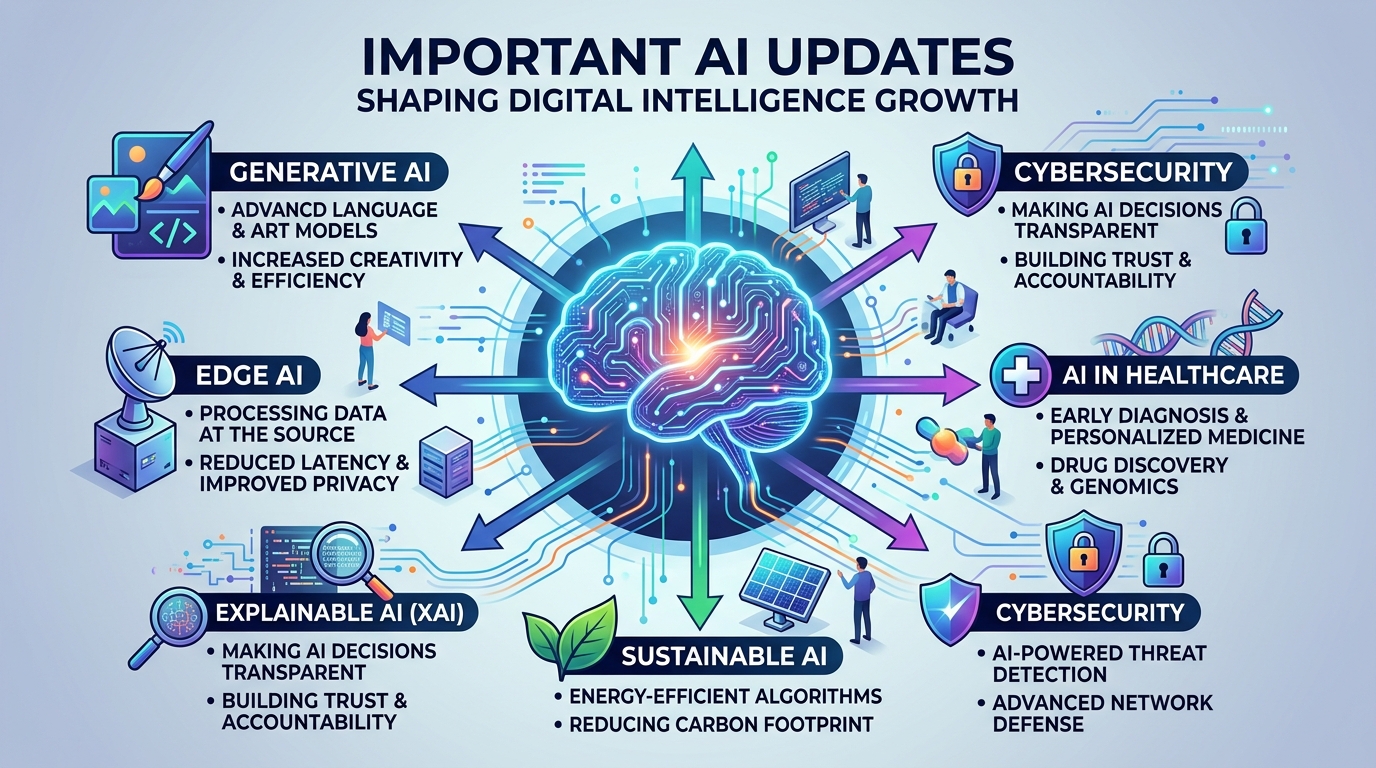
Important AI updates are rapidly shaping digital intelligence growth across industries, transforming how businesses operate, how people communicate, and how technology evolves globally. From advanced machine learning models to intelligent automation systems, these developments are accelerating innovation, improving efficiency, and redefining the future of digital ecosystems worldwide today.
AI Model Breakthroughs
Large Language Model Evolution
Large language models are evolving rapidly with improved reasoning capabilities, multimodal understanding, and contextual awareness that enhance digital intelligence systems across industries These advancements enable more accurate responses, better decision making, and smarter automation tools that support businesses, developers, and users in real time applications.
Multimodal AI Systems
Multimodal AI systems integrate text, image, audio, and video processing to create more advanced and human like digital intelligence These systems improve user experience, enable richer interactions, and support industries such as education, healthcare, and entertainment with more accurate and context aware technological solutions systems.
AI Model Efficiency Improvements
Recent AI model efficiency improvements focus on reducing computational costs, improving response speed, and optimizing energy usage across large scale systems These advancements allow organizations to deploy smarter models faster while maintaining accuracy, scalability, and performance across cloud and edge computing environments globally today now.
Open Source AI Expansion
Open source AI development is expanding rapidly as global communities collaborate on building accessible machine learning frameworks and tools This movement accelerates innovation, reduces development costs, and encourages transparency while enabling startups and researchers to create advanced AI solutions more efficiently worldwide at global scale.
AI Safety Improvements
AI safety research focuses on reducing bias, improving fairness, and ensuring responsible deployment of intelligent systems across industries Developers are implementing stronger testing frameworks, alignment techniques, and monitoring tools to prevent harmful outputs and ensure trustworthy AI behavior in real world applications globally today now.
Agentic AI Systems
Autonomous AI Agents
Autonomous AI agents are capable of performing complex tasks independently by planning, reasoning, and executing actions without constant human intervention These systems are transforming industries by improving productivity, automating workflows, and enabling intelligent decision making across business environments and digital platforms at global scale.
AI Task Automation Agents
AI task automation agents handle repetitive digital processes such as scheduling, data entry, and customer interactions efficiently These intelligent systems reduce human workload, improve accuracy, and allow organizations to focus on strategic operations while maintaining consistent productivity across multiple industries and platforms globally today now.
AI Planning Systems
AI planning systems enable machines to break down goals into structured steps, optimize decision pathways, and execute multi stage operations efficiently These systems are increasingly used in logistics, robotics, and enterprise management to improve efficiency and ensure accurate results across complex environments at global scale.
AI Decision Making Systems
AI decision making systems analyze large datasets to support faster and more accurate business and operational decisions These systems reduce uncertainty, identify patterns, and provide predictive insights that help organizations improve efficiency, minimize risks, and enhance performance across various industries globally at global scale today.
AI Collaboration Agents
AI collaboration agents assist teams by coordinating communication, managing tasks, and improving workflow efficiency across digital platforms These systems enhance teamwork, reduce delays, and ensure seamless collaboration between departments, enabling organizations to achieve goals faster and more effectively in competitive business environments globally today now.
AI in Business Automation
Workflow Automation Systems
Workflow automation systems streamline business processes by reducing manual tasks, improving efficiency, and increasing operational speed across departments These systems help organizations minimize errors, save time, and optimize resource allocation while ensuring consistent performance across digital business environments globally at global scale today now efficiency gains.
AI Driven CRM Systems
AI driven CRM systems enhance customer relationship management by analyzing data, predicting customer needs, and improving engagement strategies These systems help businesses increase sales, personalize marketing, and strengthen customer loyalty while optimizing communication and operational efficiency across digital platforms globally at global scale today improving.
Robotic Process Automation
Robotic process automation uses software bots to perform repetitive business tasks such as data entry, reporting, and transaction processing This technology reduces operational costs, improves accuracy, and increases productivity across industries by automating routine workflows and enabling employees to focus on higher value tasks globally.
Predictive Business Analytics
Predictive business analytics uses AI algorithms to forecast trends, customer behavior, and market movements These insights help organizations make informed decisions, reduce risks, and improve strategic planning while enhancing competitiveness and operational efficiency across global industries and digital business environments at global scale today improving.
AI Supply Chain Optimization
AI supply chain optimization improves logistics efficiency by predicting demand, managing inventory, and reducing delivery delays These systems help businesses streamline operations, reduce costs, and enhance customer satisfaction while ensuring smooth coordination across suppliers, manufacturers, and distributors in global markets at global scale today improving.
AI in Healthcare
Medical Diagnosis AI
AI powered medical diagnosis systems analyze patient data, imaging scans, and symptoms to detect diseases early and accurately These technologies assist doctors in making faster decisions, improving treatment outcomes, and reducing diagnostic errors across hospitals and healthcare facilities globally at global scale today now improving.
AI Drug Discovery
AI driven drug discovery accelerates pharmaceutical research by analyzing biological data, predicting molecular interactions, and identifying potential treatments faster This technology reduces research costs, shortens development timelines, and improves accuracy in finding effective medicines for complex diseases across global healthcare systems at global scale today.
Remote Patient Monitoring
Remote patient monitoring uses AI enabled devices and sensors to track patient health in real time outside clinical settings These systems improve healthcare accessibility, reduce hospital visits, and enable early intervention for chronic diseases through continuous data analysis and predictive insights at global scale today.
Personalized Medicine AI
Personalized medicine AI tailors medical treatment plans based on individual genetic, lifestyle, and health data These systems improve treatment effectiveness, reduce side effects, and enhance patient care by providing targeted therapies optimized for each person’s unique biological profile and medical history at global scale today.
Healthcare Workflow AI
Healthcare workflow AI streamlines hospital operations by automating administrative tasks, scheduling, and patient management processes These systems reduce workload for medical staff, improve efficiency, and enhance service delivery across hospitals while ensuring better coordination between departments and healthcare providers globally at global scale today improving.
AI Ethics & Regulation
AI Governance Policies
AI governance policies establish rules and frameworks to ensure responsible development and deployment of artificial intelligence systems These regulations focus on transparency, accountability, fairness, and safety while guiding organizations to use AI ethically across industries and global digital ecosystems effectively at global scale today improving.
AI Bias Mitigation
AI bias mitigation focuses on identifying and reducing unfair patterns in machine learning models to ensure equitable outcomes These efforts improve fairness, accuracy, and trustworthiness while preventing discrimination in automated decision making systems used across industries and global applications worldwide at global scale today improving.
Responsible AI Development
Responsible AI development emphasizes creating ethical, transparent, and safe artificial intelligence systems that benefit society Developers focus on reducing risks, ensuring accountability, and building trust while designing AI technologies that align with human values and global regulatory standards across industries at global scale today improving.
AI Privacy Protection
AI privacy protection ensures that personal and sensitive data is securely handled within intelligent systems These technologies implement encryption, access controls, and compliance frameworks to safeguard user information while maintaining trust and regulatory compliance across digital platforms and global networks at global scale today improving.
AI Regulatory Challenges
AI regulatory challenges arise due to rapid technological advancement, requiring governments to create balanced policies that support innovation while ensuring safety These challenges include data governance, ethical concerns, and international coordination across jurisdictions for effective AI oversight and compliance globally at global scale today improving.
AI Infrastructure & Chips
AI Chip Innovation
AI chip innovation focuses on developing high performance processors optimized for machine learning workloads and large scale computations Companies are designing specialized hardware to accelerate AI training, reduce energy consumption, and improve computational efficiency across data centers and edge devices globally at global scale today.
Cloud AI Infrastructure
Cloud AI infrastructure enables scalable deployment of artificial intelligence models across distributed computing environments These platforms support training, inference, and data processing at massive scale, helping organizations reduce costs, improve performance, and accelerate innovation across industries and global digital ecosystems at global scale today improving.
Edge AI Systems
Edge AI systems process data locally on devices rather than relying entirely on cloud servers This reduces latency, improves speed, and enhances privacy while enabling real time decision making for applications such as autonomous vehicles, smart cities, and industrial automation systems globally at global scale.
AI Data Centers Growth
AI data centers are expanding rapidly to support increasing computational demands of artificial intelligence workloads These facilities provide high performance computing, storage, and networking capabilities that enable large scale model training and deployment across global digital infrastructure systems at global scale today now improving efficiency.
AI Hardware Acceleration
AI hardware acceleration improves processing speed by using specialized chips and architectures designed for machine learning tasks These advancements reduce computation time, enhance performance, and support large scale AI applications across industries, enabling faster and more efficient digital transformation globally at global scale today improving.
Future AI Trends
Human AI Collaboration
Human AI collaboration is becoming a key trend where intelligent systems work alongside humans to enhance productivity, creativity, and decision making These technologies support workplaces, education, and research environments by combining human intuition with machine intelligence for better outcomes across industries globally at global scale.
Autonomous AI Systems
Autonomous AI systems are evolving to perform complex tasks independently with minimal human intervention These systems are expected to transform industries such as transportation, healthcare, and manufacturing by improving efficiency, reducing costs, and enabling intelligent decision making across global digital environments at global scale today.
AI in Creativity
AI in creativity is revolutionizing content creation by assisting in writing, music, art, and design processes These tools enable creators to produce high quality content faster, explore new ideas, and enhance artistic expression while collaborating with intelligent systems across digital platforms globally at global scale.
AI Driven Smart Cities
AI driven smart cities integrate intelligent systems to optimize transportation, energy usage, public safety, and infrastructure management These technologies improve urban living standards, reduce environmental impact, and enhance efficiency through real time data analysis and automated decision making across global city networks at global scale.
Ethical Future AI
Ethical future AI focuses on developing intelligent systems that prioritize fairness, transparency, accountability, and human well being Researchers and developers aim to ensure AI technologies remain safe, unbiased, and beneficial while supporting global innovation and responsible digital transformation across industries at global scale today improving.
What are the latest AI updates today?
Latest AI updates include generative models, agentic AI systems, multimodal intelligence, and advancements in cloud and edge computing technologies.
How is AI impacting businesses globally?
AI improves automation, decision making, customer experience, and operational efficiency across industries worldwide.
What is agentic AI?
Agentic AI refers to systems that can independently plan, reason, and execute tasks without constant human input.
Why is AI regulation important?
AI regulation ensures safety, fairness, transparency, and responsible use of artificial intelligence technologies.
What is the future of AI technology?
The future of AI includes autonomous systems, human collaboration, smart cities, and advanced digital intelligence ecosystems.
Important AI updates are rapidly shaping digital intelligence growth across industries worldwide by improving automation, decision making, and innovation. These advancements in generative AI, automation, and infrastructure are transforming businesses, healthcare, and communication systems across global markets. Continuous innovation in artificial intelligence will further enhance productivity, connectivity, and global digital transformation in the coming years ahead at global scale now
