

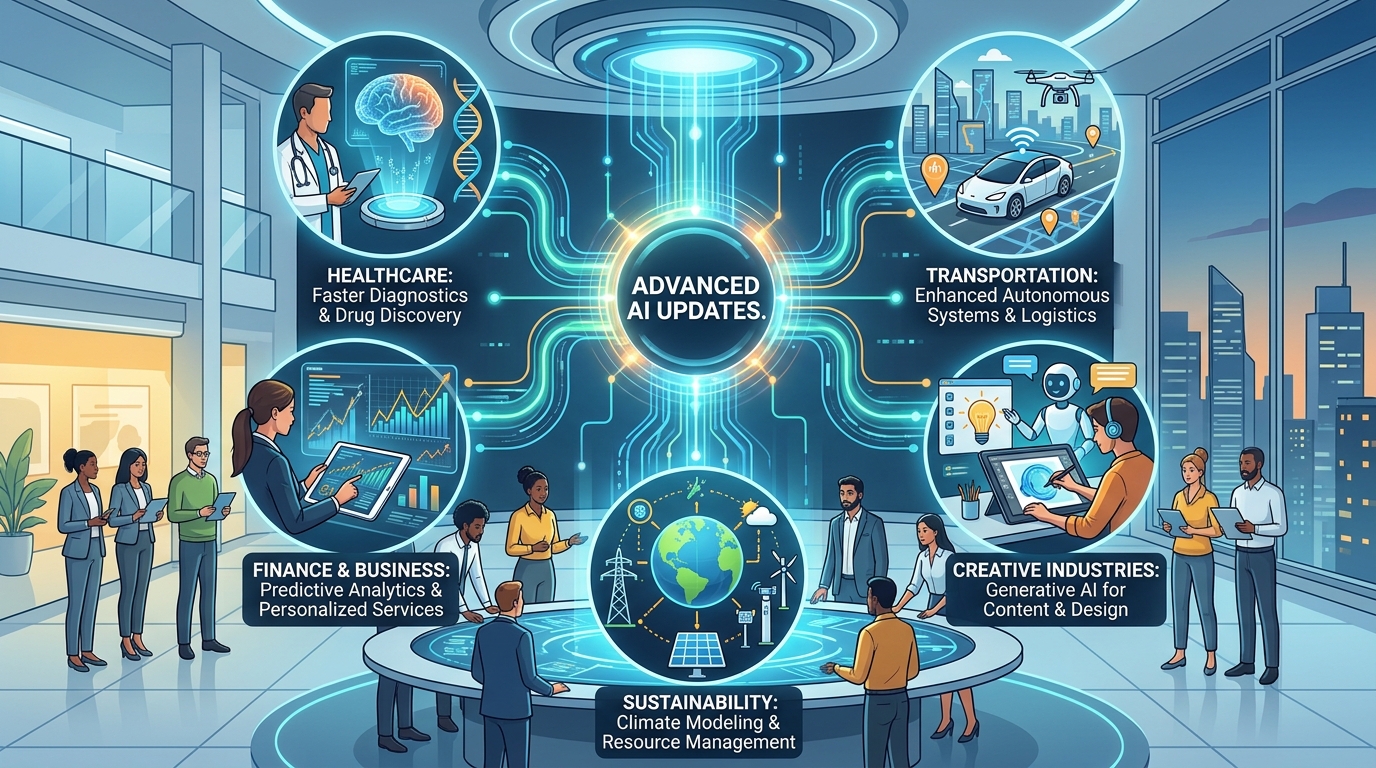
AI is no longer just improving software—it is actively reshaping search engines, operating systems, robotics, education, and even filmmaking. The biggest change is the rise of agentic AI systems, where models don’t just respond but actually perform tasks, make decisions, and operate across apps and devices in real time.
Global AI Agent Revolution and “Agentic Era”
AI Moving From Tools to Autonomous Agents
Tech companies are shifting from simple chatbots to fully autonomous AI agents that can plan, execute, and complete multi-step tasks. These systems are now integrated into productivity apps, search engines, and cloud platforms, changing how users interact with technology.
Gemini and Agentic Ecosystems Expansion
Google has introduced a more advanced “Agentic Gemini” system, embedding AI across Search, Android, and Workspace, allowing it to act across apps instead of just answering queries. This marks a major platform shift in global AI infrastructure.
AI Assistants Becoming Personal Digital Workers
AI assistants are now connecting with personal data like emails, calendars, and documents to automate scheduling, research, and communication tasks. This is creating a new category of “personal intelligence systems” used in everyday life.
Multi-Agent Collaboration Systems
New AI frameworks allow multiple agents to collaborate on complex workflows such as software development, business planning, and scientific research. This improves efficiency and reduces human workload across industries.
Enterprise Adoption of Agentic AI
Companies are rapidly deploying AI agents in customer service, cybersecurity, and operations. These systems are reducing operational costs while increasing speed and decision accuracy in real business environments.
Breakthrough AI Models and Multimodal Intelligence
Gemini 3.5 and Omni Model Launch
New AI models like Gemini 3.5 Flash and Gemini Omni bring faster reasoning and deeper multimodal capabilities, handling text, images, audio, and video in a unified system for smarter outputs.
Rise of True Multimodal AI Systems
AI systems are now designed to understand and generate across multiple formats simultaneously, enabling applications like real-time video editing, voice-controlled coding, and visual search enhancements.
Faster and Cheaper AI Processing Models
New lightweight AI models are being optimized for speed and cost efficiency, allowing large-scale deployment in mobile devices and cloud services without heavy infrastructure requirements.
AI Memory and Context Expansion
Modern models are being enhanced with long-term memory features, allowing them to remember user preferences and past interactions for more personalized responses.
Specialized Industry AI Models
Companies are developing domain-specific AI models for healthcare, finance, engineering, and education, improving accuracy and reducing general-purpose errors in critical sectors.
AI Integration in Search, Apps, and Daily Platforms
AI Search Overhaul
Search engines are being redesigned into conversational AI systems that provide direct answers, summaries, and task execution instead of traditional link-based results.
AI in Productivity Suites
Tools like Docs, Gmail, and Workspace are now powered by AI that can write, summarize, and automate tasks using voice or text commands.
AI-Powered App Creation
Developers can now build full applications using natural language prompts, significantly reducing coding complexity and speeding up software development cycles.
Smart Shopping and Recommendation Systems
AI-driven shopping systems now compare products, optimize carts, and suggest purchases based on user behavior and real-time pricing trends.
Wearable AI and Smart Devices
Smart glasses and wearable AI devices are returning, allowing users to interact with digital assistants through voice, vision, and augmented reality interfaces.
Robotics, Automation, and Physical AI Systems
Humanoid Robot Development
Robotics companies are advancing humanoid systems capable of performing warehouse, logistics, and manufacturing tasks with increasing precision and adaptability.
AI in Industrial Automation
Factories are integrating AI-driven robotics to improve production speed, reduce defects, and manage complex assembly tasks with minimal human intervention.
Digital Twin and Simulation AI
AI is being used to create digital replicas of physical systems for testing and optimization before real-world deployment, improving safety and efficiency.
Edge AI for Real-Time Decisions
Robots and machines are increasingly processing data locally using edge computing, enabling instant responses without cloud dependency.
Human-Robot Collaboration
Modern AI robots are designed to work alongside humans safely, improving productivity in industries like manufacturing, healthcare, and logistics.
AI in Science, Research, and Innovation
AI Accelerating Scientific Discovery
AI systems are now being used in labs to simulate experiments, analyze data, and suggest hypotheses, significantly speeding up research cycles.
Breakthrough in Material and Energy Research
AI is helping scientists design new materials, optimize energy systems, and improve battery efficiency for next-generation technologies.
AI in Healthcare Diagnostics
Medical AI tools are improving disease detection accuracy through advanced image recognition and predictive modeling techniques.
AI-Powered Climate Modeling
Researchers are using AI to predict weather patterns, climate change effects, and environmental risks with higher precision than traditional models.
Autonomous Research Labs
Fully AI-driven research labs are emerging, where systems independently conduct experiments and refine hypotheses without constant human supervision.
AI Governance, Ethics, and Global Regulation
Rising AI Regulation Worldwide
Governments are introducing strict frameworks to regulate AI safety, transparency, and responsible deployment across industries.
AI Safety and Content Authentication
New tools are being developed to detect AI-generated content and prevent misinformation using watermarking and verification systems.
Data Privacy Protection Expansion
Stronger global data laws are being implemented to ensure user privacy and secure handling of sensitive AI training data.
Ethical AI Development Focus
Tech companies are prioritizing fairness, bias reduction, and accountability in AI model training and deployment processes.
International AI Cooperation
Countries are collaborating on AI standards, infrastructure sharing, and research initiatives to balance innovation with global safety.
Future AI Trends Shaping Technology
Shift Toward Fully Autonomous Systems
AI is evolving toward systems that operate independently across digital ecosystems without constant human input.
AI + Quantum Computing Integration
Research is advancing toward combining AI with quantum computing to solve complex problems beyond classical computing limits.
AI-First Internet Ecosystem
The internet is gradually transforming into an AI-first environment where agents interact directly with services on behalf of users.
Hyper-Personalized Digital Experiences
Every user interaction is becoming increasingly personalized based on behavior, preferences, and real-time context.
Continuous AI Evolution Cycle
AI systems are now self-improving through feedback loops, making innovation cycles faster than ever before.
FAQs
What is the biggest AI trend right now?
The biggest trend is agentic AI systems that can perform tasks autonomously across apps and platforms.
How is AI changing search engines?
Search engines are becoming conversational tools that give direct answers instead of just showing links.
What are multimodal AI systems?
They are AI models that understand and generate text, images, audio, and video together.
Is AI affecting jobs globally?
Yes, AI is automating tasks in many industries while also creating new roles in tech and data fields.
What is the future of AI technology?
The future includes fully autonomous agents, smarter robotics, and integration with quantum computing.
Conclusion
AI is rapidly transforming the global technology landscape through autonomous agents, multimodal models, and deep integration into daily digital platforms. These advancements are reshaping industries, accelerating innovation, and redefining human interaction with machines. As AI continues evolving, it is becoming the foundation of the next generation of intelligent, connected, and automated global systems.
