

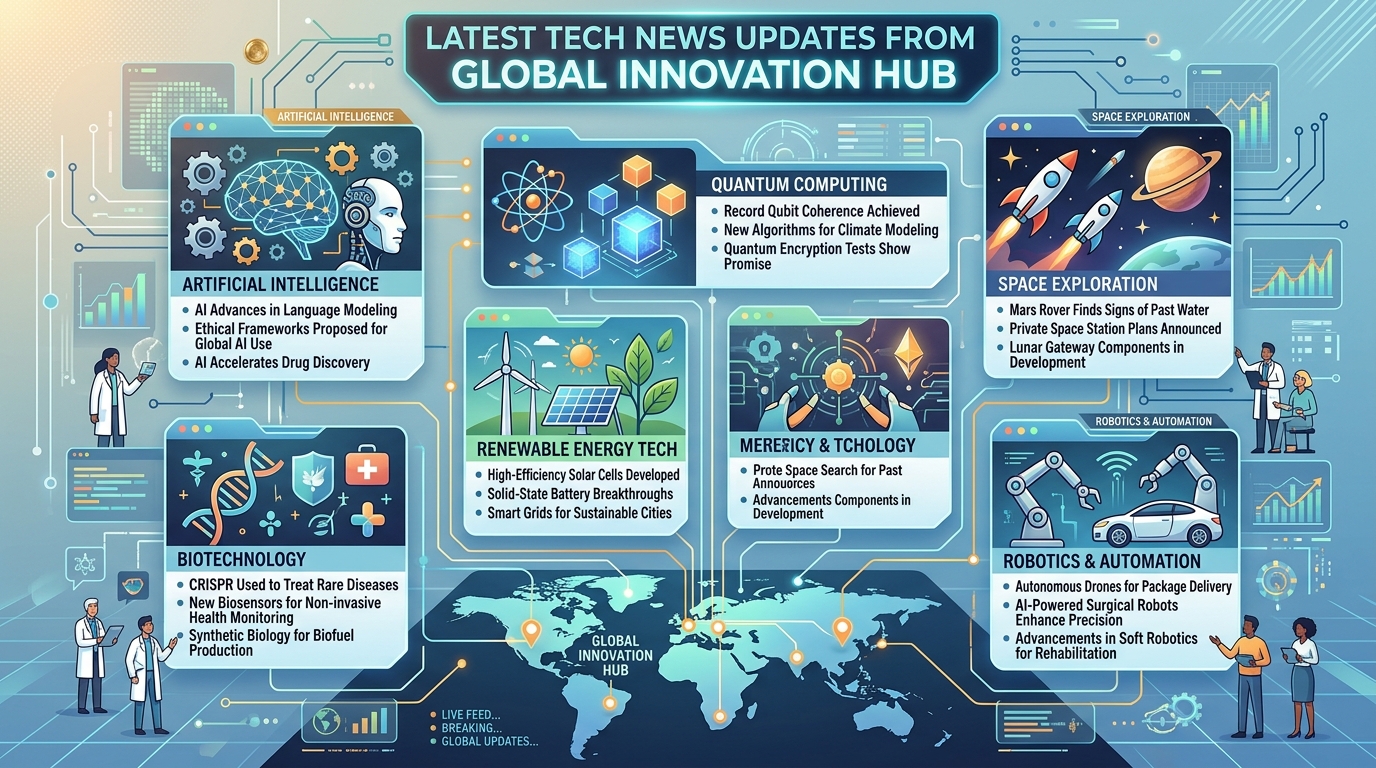
The global technology landscape is moving at an extraordinary pace, driven mainly by artificial intelligence, chip innovation, and large-scale infrastructure investments. From breakthroughs in semiconductor engineering to record-breaking AI funding rounds, today’s updates reflect a world rapidly transitioning into a fully AI-powered digital economy where competition, innovation, and geopolitics are deeply interconnected across industries worldwide.
AI Chip Revolution and Semiconductor Breakthroughs
Next-Gen Chip Architecture Innovation
Major tech players are pushing advanced chip design strategies to overcome physical limits in semiconductor scaling. New approaches focus on optimizing data flow and reducing latency rather than shrinking transistors, marking a shift toward architectural efficiency over traditional miniaturization in computing systems.
Advanced Manufacturing Expansion
Chip manufacturers are scaling production capabilities to meet surging AI demand. Facilities are being expanded globally, especially in regions like the United States and Asia, to support next-generation AI workloads and high-performance computing infrastructure requirements.
AI-Optimized Hardware Integration
Companies are increasingly embedding AI directly into semiconductor production tools. This improves defect detection, boosts yield efficiency, and enhances chip quality, enabling faster production cycles and more reliable high-performance processors for global technology markets.
Global Chip Supply Pressure
The semiconductor industry continues to face tight supply conditions driven by explosive AI demand. Memory chips and advanced packaging components are particularly constrained, creating pricing pressure and extended delivery timelines across multiple hardware segments.
Strategic Semiconductor Rivalries
Geopolitical competition is intensifying in the chip sector as nations and companies race for technological self-sufficiency. Domestic chip ecosystems are expanding rapidly to reduce reliance on foreign supply chains and secure long-term innovation leadership.
Artificial Intelligence Expansion Across Industries
Massive AI Investment Growth
Global companies are investing heavily in AI infrastructure, with spending reaching hundreds of billions of dollars annually. This surge reflects confidence that AI will dominate future computing, business operations, and digital transformation across all major industries.
AI Model Advancement
Next-generation AI models are becoming more powerful, efficient, and specialized. These systems are increasingly designed for industry-specific applications such as healthcare diagnostics, financial forecasting, and automated engineering workflows.
Enterprise AI Adoption
Businesses across sectors are integrating AI tools into daily operations to improve productivity, reduce costs, and automate decision-making processes. This shift is accelerating digital transformation at a global scale across enterprises of all sizes.
AI Robotics Development
AI-powered robotics is advancing rapidly, enabling machines to perform complex physical tasks in manufacturing, logistics, and service industries. These systems combine vision, reasoning, and motion control for real-world adaptability.
Ethical AI Regulation
Governments are introducing new frameworks to regulate AI usage, focusing on transparency, data protection, and responsible deployment. These policies aim to balance innovation with safety and public trust in emerging technologies.
Global Tech Industry and Startup Ecosystem
Startup Funding Surge
Technology startups are receiving significant funding, particularly in AI, fintech, and deep tech sectors. Investors are prioritizing scalable innovations that demonstrate strong potential for automation and enterprise integration.
Big Tech Competition
Leading technology companies are competing aggressively in AI, cloud computing, and hardware innovation. This rivalry is driving rapid product development cycles and accelerating global digital transformation trends.
Cloud Infrastructure Growth
Cloud computing platforms are expanding capacity to support growing AI workloads. Data centers are being upgraded with specialized chips and energy-efficient systems to handle massive computational demand.
Software Ecosystem Evolution
Software development is shifting toward AI-native platforms where applications are increasingly built with embedded intelligence, enabling automation, personalization, and predictive capabilities across user experiences.
Global Innovation Collaboration
International partnerships between research institutions, governments, and corporations are fostering cross-border innovation. These collaborations aim to accelerate breakthroughs in computing, energy efficiency, and advanced manufacturing.
Robotics and Automation Breakthroughs
Humanoid Robotics Progress
Humanoid robots are entering early commercialization stages, designed for industrial and logistics tasks. These systems are improving in mobility, reasoning, and real-time decision-making.
Industrial Automation Expansion
Factories are increasingly adopting automated systems powered by AI and machine learning. This enhances production speed, reduces human error, and improves operational efficiency in manufacturing environments.
Edge Computing Integration
Robotics systems are integrating edge computing to process data locally, reducing latency and enabling faster real-time responses in dynamic environments such as warehouses and factories.
Sensor Technology Improvements
Advanced sensors are enabling robots to better understand their surroundings through improved vision, touch, and spatial awareness systems, significantly increasing operational precision.
Human–Machine Collaboration
Modern robotics systems are designed to work alongside humans, enhancing productivity while maintaining safety standards in shared industrial and service environments.
Cybersecurity and Digital Safety Updates
Rising Cyber Threats
Cyberattacks are becoming more sophisticated, targeting critical infrastructure, financial systems, and corporate networks. Organizations are strengthening defenses to counter evolving digital threats.
AI-Powered Security Systems
AI is being deployed to detect and prevent cyber threats in real time. These systems analyze patterns and identify anomalies faster than traditional security tools.
Data Protection Regulations
Governments worldwide are introducing stricter data protection laws to safeguard user privacy and regulate digital platforms more effectively in an increasingly connected world.
Cloud Security Enhancements
Cloud providers are upgrading encryption systems and identity management tools to secure massive volumes of sensitive data stored across distributed infrastructures.
Global Security Collaboration
International cybersecurity partnerships are strengthening to share threat intelligence and coordinate responses against large-scale digital attacks targeting global systems.
Space Technology and Exploration Advances
Satellite Deployment Growth
Satellite launches are increasing to support global communication, Earth observation, and internet connectivity. These systems play a critical role in modern digital infrastructure.
Deep Space Missions
Space agencies are expanding missions to explore the Moon, Mars, and beyond. These efforts aim to enhance scientific understanding and test advanced exploration technologies.
Private Space Industry Expansion
Private companies are investing heavily in space technology, driving innovation in reusable rockets, satellite networks, and commercial space travel services.
Space-Based Internet Systems
Low-Earth orbit satellite networks are expanding global internet access, particularly in remote regions, bridging digital divides and improving connectivity worldwide.
Advanced Space Engineering
New engineering breakthroughs are improving propulsion systems, spacecraft durability, and mission efficiency, enabling longer and more complex space exploration missions.
Digital Economy and Future Tech Trends
AI-Driven Economic Growth
Artificial intelligence is becoming a central driver of global economic expansion, influencing productivity, innovation, and market competitiveness across industries.
Digital Transformation Acceleration
Organizations are rapidly digitizing operations to remain competitive, adopting AI, automation, and cloud technologies to streamline processes and improve efficiency.
Smart Devices Evolution
Connected devices are becoming more intelligent, integrating AI features that enhance user experience, personalization, and real-time decision-making capabilities.
Blockchain and Decentralized Systems
Blockchain technology continues evolving beyond cryptocurrencies, supporting secure transactions, digital identity systems, and decentralized applications across industries.
Future Technology Forecasting
Experts predict continued convergence of AI, robotics, quantum computing, and advanced manufacturing, shaping the next phase of global technological evolution.
FAQs
What is driving global tech innovation in 2026?
Artificial intelligence, semiconductor advancement, and massive infrastructure investment are the main drivers of global tech innovation.
Why is the semiconductor industry so important now?
It powers AI systems, cloud computing, and advanced electronics, making it essential for modern digital infrastructure.
How is AI changing industries globally?
AI is automating tasks, improving decision-making, and enabling smarter systems across healthcare, finance, and manufacturing.
What are the biggest risks in tech growth today?
Cybersecurity threats, supply chain pressure, and ethical concerns around AI deployment are key risks.
Which technologies will dominate the future?
AI, robotics, quantum computing, and advanced semiconductors are expected to dominate future technological development.
Conclusion
Global tech innovation is accelerating through AI breakthroughs, semiconductor advancements, robotics growth, and expanding digital ecosystems worldwide. These developments are reshaping industries, economies, and daily life at unprecedented speed. As competition intensifies, the future will be defined by smarter systems, stronger connectivity, and continuous innovation driving the next digital transformation era across the world.
